



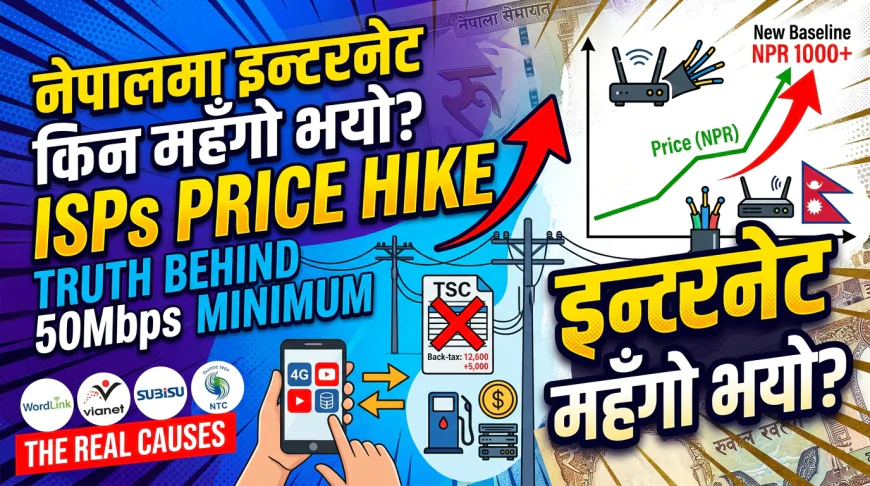
Nepal’s digital broadband ecosystem has reached a major structural tipping point. Over the past few years, Internet Service Providers (ISPs) across Nepal engaged in high-stakes competition to onboard household subscribers. Today, however, consumers are noticing a significant shift: entry-level, low-cost broadband packages are disappearing, and overall subscription rates are creeping upward.
According to directions from the Internet Service Providers' Association of Nepal (ISPAN), major operators—including WorldLink, Vianet, Subisu, and Classic Tech—have largely phased out lower-tier 20 Mbps and 30 Mbps plans, establishing 50 Mbps as the new baseline speed.
This transition has triggered widespread concern among light internet users, students, and low-income households. To understand this dynamic, we must examine the corporate strategy behind broadband expansion, the operational cost pressures ISPs face, and the shifting consumer behaviors resulting from these price hikes.
ISPs को Business Strategy: Hook, Depend, and Upsell
(The "Hook and Lock-In" Corporate Playbook)
To understand why prices are rising now, it is necessary to examine how Nepal's fiber broadband market was initially built.
Hook Phase (सुरुवाती ग्राहक आकर्षण):
केही वर्ष अघि ISPs हरूले "स्पीड वार" (Speed War) चलाएर ५००–७०० रुपैयाँमै सस्तो प्याकेज, फ्री राउटर र नि:शुल्क इन्स्टोलेसन दिएर घर-घरमा फाइबर (FTTH) पुर्याए। They operated on slim profit margins to capture market share and establish high brand visibility.
Dependency & Lock-In (निर्भरता निर्माण):
जब मानिसहरू अनलाइन क्लास, वर्क फ्रम होम, डिजिटल वालेट (eSewa, Khalti), टिकटक, र युट्युबका लागि पूर्ण रूपमा वाइफाइमा निर्भर भए, इन्टरनेट विलासिता नभएर अत्यावश्यक सेवा (Essential Service) बन्यो। The switching cost—buying new routers, paying re-installation fees, or changing cables—became too high for average consumers.
Forced Upselling (प्याकेज अपग्रेडको दबाब):
ISP हरूले सीधै "हामीले भाडा बढायौँ" भन्नुको सट्टा रणनीति बदल्यो। उनीहरूले ५० Mbps भन्दा तलका सस्ता प्याकेजहरू बजारबाट हटाइदिए। अब ग्राहकले नचाहेर पनि महँगो प्याकेज (रू. ९००–१०००/महिना वा वर्षको रू. १४,०००+) लिनैपर्ने बाध्यता सिर्जना भएको छ।
When an association like ISPAN acts collectively across the sector, it eliminates market competition at the lowest tier, creating an artificial price floor across the industry.
ISPs को दाबी: मूल्य बढाउनुको पछाडिको वास्तविक बाध्यता
(Why ISPs Claim Price Hikes Are Unavoidable)
While consumers view the price hikes as cartel-like behavior, service providers point to serious backend structural costs and legal challenges that threaten their solvency:
Supreme Court Ruling on Telecommunication Service Charge (TSC)
The primary legal catalyst stems from a long-standing dispute between ISPs and the Government of Nepal over the Telecommunication Service Charge (TSC).
Historically, ISPs separated customer bills into basic bandwidth and "maintenance/support fees," applying the 10% TSC tax only to the bandwidth portion.
The government ruled that TSC applies to the entire billed amount.
Following a Supreme Court verdict upholding the government's stance, ISPs are now facing retroactive tax assessments and penalties dating back to 2018—costing billions of Nepalese Rupees.
Nepal Electricity Authority (NEA) Pole Rental Fees
A continuous point of friction in Nepal's IT sector is the utility line rental fee. The Nepal Electricity Authority (NEA) regularly revises rates for optical fiber lines mounted on electric poles. Operating costs for line maintenance and pole usage have escalated substantially over recent years.
Upstream Foreign Currency Expenses
Nepal imports almost all of its international internet bandwidth from upstream tier-1 providers (primarily in India). Because bandwidth, optical equipment, ONTs, and routing chipsets are purchased in US Dollars (USD) or Indian Rupees (INR), foreign exchange fluctuations directly impact operating budgets.
What This Means for Consumers: A Shift Back to Mobile Data?
(ग्राहकहरू फेरि Mobile Data तर्फ फर्कने सम्भावना)
As broadband prices rise, budget-conscious consumers—particularly students living in rented rooms, small vendors, and light internet users—are re-evaluating their household expenses.
| Broadband Shift Dynamics | Impact on Daily Users |
| Phasing Out Budget Plans | Minimum monthly internet bill rises from ~NPR 600 to ~NPR 950+. |
| Increased Bill Sharing | Multiple households or neighbors sharing a single 50 Mbps line to divide the monthly cost. |
| Pivot to Mobile Data | Light users shifting to specialized NTC or Ncell data packs for essential tasks. |
For light internet users who primarily check messaging apps, perform digital wallet transactions, or stream minimal video content, paying over NPR 1,000 per month for fixed broadband is becoming economically impractical.
As a result, a portion of the market is expected to adopt a hybrid connectivity strategy:
Targeted Data Packs: Utilizing daily unlimited or platform-specific data packs (e.g., social media or video streaming bundles) from cellular networks like NTC and Ncell.
Public Wi-Fi & Shared Fiber: Sharing broadband credentials or costs across multiple roommates to lower the individual financial burden.
Migration to NT Fiber: Looking toward state-owned alternatives like Nepal Telecom's FTTH packages, which are often perceived as maintaining lower baseline rates.
Regulatory Oversight and the Future of Digital Nepal
Internet access is no longer a luxury; it is the fundamental backbone of modern education, banking, commerce, and governance. The collective discontinuation of entry-level packages under ISPAN raises key policy questions regarding consumer rights and fair market competition.
The Nepal Telecommunications Authority (NTA) mandates that tariff adjustments undergo strict review before being implemented. Moving forward, regulatory intervention will be crucial to ensure that while ISPs remain financially viable, everyday citizens are not priced out of essential digital infrastructure.